
Chhath Puja — A Four-Day Journey Through Ritual and Meaning
Chhath Puja — A Four-Day Journey Through Ritual and Meaning
Chhath doesn’t arrive all at once. It unfolds slowly, almost like a rhythm the household settles into. Each day carries its own pace—starting with quiet preparation, moving into discipline, and then opening up into collective devotion by the river. By the time it ends, it feels less like an event and more like something the entire family has lived through together.
Day One — Nahay Khay: Preparing the Body, the Home, and the Mind
The first day begins with water. Devotees take a ritual bath—often in a river, pond, or at home with the same sense of care—and from that moment, the house itself begins to change. Kitchens are cleaned thoroughly, sometimes even separated for cooking prasad, and an atmosphere of purity quietly settles in.
Food on this day is simple but prepared with attention. Rice, dal, and vegetables (especially bottle gourd) are cooked without garlic or onion, often using new or specially cleaned utensils. It is usually the woman observing the vrat who eats this meal first, but the entire family adjusts around her—helping with preparation, maintaining cleanliness, and ensuring everything follows the discipline the ritual demands.
There’s a sense of slowing down here. Conversations soften, routines shift, and the household begins to move in sync with the vrat.
Day Two — Kharna: A Day of Restraint and Quiet Strength
The second day carries a different weight. From sunrise until evening, the vratin observes a strict fast—no food, no water. The home, meanwhile, becomes quietly attentive. Family members take on responsibilities—cooking, cleaning, arranging—so the person fasting can remain undisturbed.
As evening approaches, the kitchen comes alive again, but with even greater care. The prasad for Kharna—typically kheer made with jaggery, along with roti—is prepared in a calm, almost meditative manner. Nothing is rushed, nothing is casual.
When the offering is made, it becomes a shared moment. The vratin breaks the day-long fast with this prasad, and it is then distributed among family and neighbours. It feels less like a meal and more like a quiet gathering—one that marks the beginning of the much more intense 36-hour fast that follows.
Day Three — Sandhya Arghya: Gathering at the Water’s Edge
By the third day, the festival steps out of the home and into the open. Preparations begin early—bamboo baskets are arranged with fruits, thekua, sugarcane, and other offerings. Every item is placed thoughtfully, often by multiple hands working together.
Families walk together to the ghat or water body, carrying these offerings. There’s a sense of togetherness in this movement—children helping hold baskets, elders guiding, neighbours joining along the way.
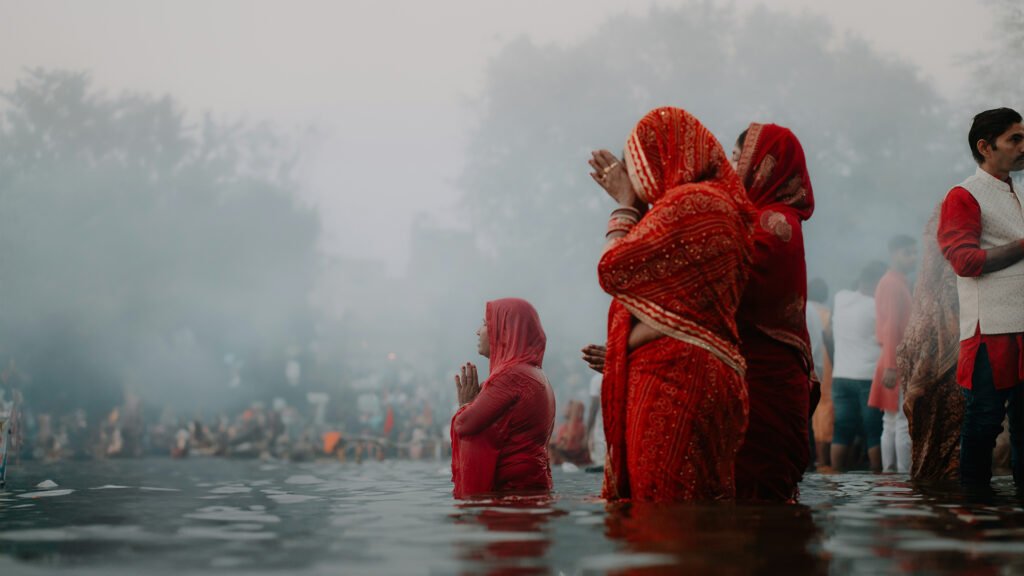
As the sun begins to set, devotees step into the water. The moment is still and expansive at the same time. Lamps are lit, songs are sung softly, and the setting sun is offered prayers.
What stands out here is the balance—this is both deeply personal and quietly collective. Each person stands in their own devotion, yet surrounded by hundreds doing the same.
Day Four — Usha Arghya: Waiting for the First Light
The final morning begins before dawn. There’s a gentle urgency as families wake up, gather the offerings again, and make their way back to the water. The air feels different—cooler, quieter, filled with anticipation.
Standing in the water once more, devotees wait for the first rays of the sun. When it appears, the offering is made again—this time to the rising sun. It is a moment that feels both like an ending and a beginning.
After this, the fast is finally broken. Back at home, prasad is shared, and the house slowly returns to its usual rhythm—but not quite the same as before.
Throughout these days, the preparation of prasad remains central. Thekua, fruits, and other offerings are made with a kind of care that goes beyond cooking. Ingredients are chosen simply, often locally, and prepared without shortcuts.
What’s noticeable is how this becomes a shared effort. Someone kneads the dough, someone shapes it, someone fries it. Even younger members of the family find small ways to contribute. It turns into a quiet collaboration, where the act of making becomes just as meaningful as the offering itself.
A Festival Held Together by People
Chhath is often described through its rituals, but what truly holds it together is the way people come together around it. Families, neighbours, even entire localities begin to move in rhythm.
Ghats are cleaned collectively. Spaces are shared without formality. There’s an unspoken understanding that everyone is part of the same experience.
The absence of elaborate priest-led rituals makes it feel closer to the people—something shaped and sustained by those who practice it.
When you look back at the four days, it’s not just the rituals that stand out. It’s the discipline of waking early, the stillness of standing in water, the care with which everything is prepared.
In a way, Chhath gently pulls life back to its basics—food, water, sunlight, and intention. It reminds you how much meaning can exist in simple, repeated acts when done with attention.
Experiencing It for the First Time
For someone new, the structure of Chhath can feel intense. The fasting, the precision, the early mornings—it can seem overwhelming from the outside.
But once you begin to follow the flow of the days, it starts to make sense. Each step prepares you for the next. Each ritual has its own pace.
And slowly, what seemed demanding begins to feel grounding.
Moving Through the Festival
Chhath is not something that happens in a single moment. It moves—through preparation, restraint, devotion, and release.
By the end of it, what remains is not just the memory of rituals, but the feeling of having gone through something—together, as a family, as a community, and in your own quiet way.